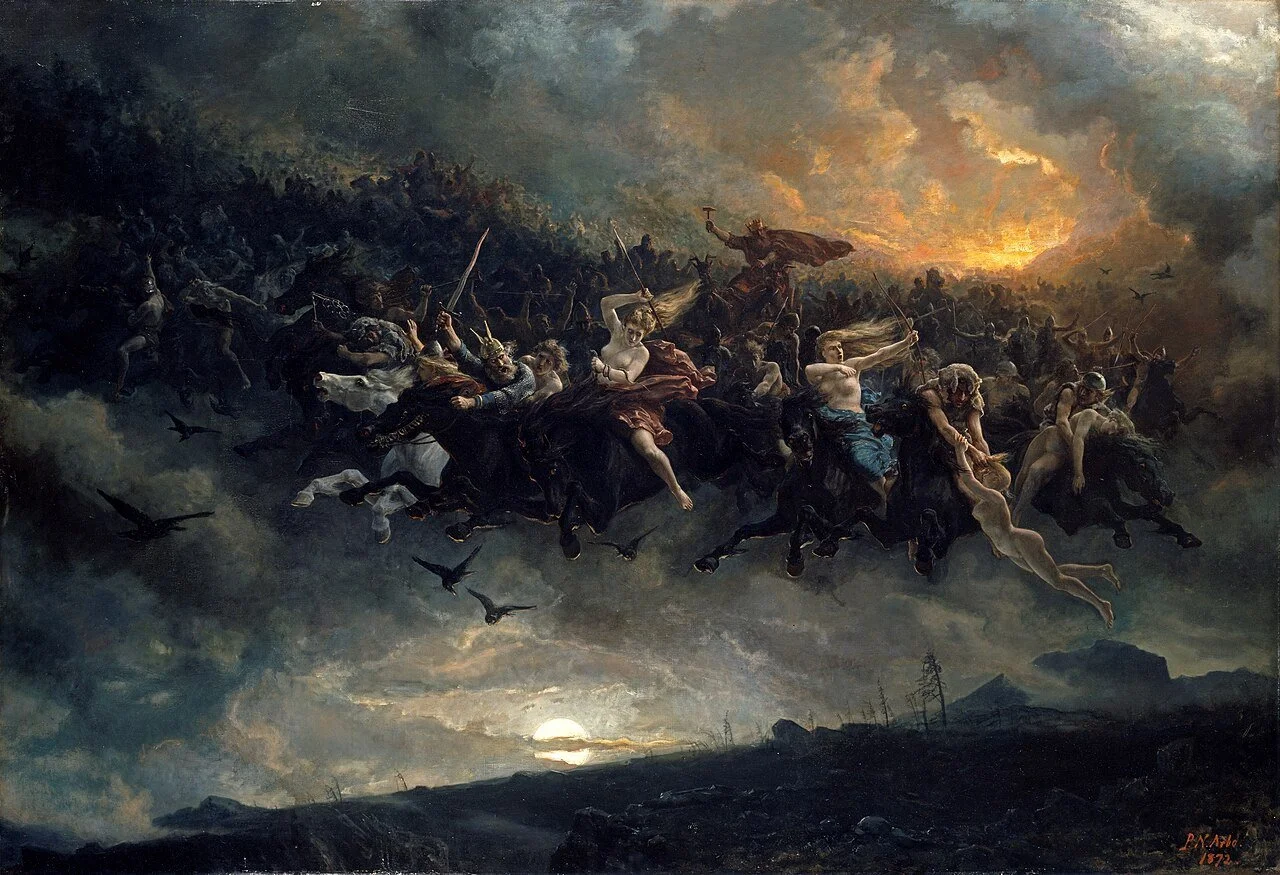
“The Wild Hunt of Odin” by the Norwegian painter Peter Nicolai Arbo
Ever since I was a young child, I was obsessed with anything ancient and medieval European history whether they were Spartans, Roman soldiers and legionnaires, Gladiators, Vikings, Knights, etc. As I have grown and matured, I have grown to deeply admire my Germanic-Scandinavian roots. This connection was forged following my epic trip to England and Scotland and my deep and intense research into my family history. As I learned more about my ancestral roots, I learned about the Scandinavian warrior code called Drótt which eventually evolved into the Hirð. Drót essentially was a professional warrior or a bodyguard to a jarl, lord or king. It was a two-way oath-bond between a lord and his personally selected men. That group of men was called a war-band. The lord would promise security, food, weapons and protection as long as they swore unwavering and unyielding fealty to him and none else. These men were honor-bound (a moral duty and unspoken word to protect those in their tribe by any means necessary). These men would follow their leader into battle and often die with him or avenge him in battle. It was extremely dishonorable to flee from battle which led to death or exile. You were to fight and/or die with your king in battle, oftentimes in a shieldwall. The Drótt evolved into the Hirð which was more organized and swore fealty to a king and his realm as opposed to a petty king or local tribe. Today, I want to talk about the principles of this Drótt culture: Drengskapr, Ætt (or Aett) and Orðstirr.
Drengskapr: Building and maintaining one’s honor and reputation, especially when unpopular or inconvenient. Integrity is paramount and non-negotiable.
Ætt: fierce, undying loyalty and devotion to one’s tribe or family. Aett doesn’t necessarily mean one’s blood family, even though it tends to lean that way.
Orðstirr: one’s accomplishments, deeds or commitment to leaving a legacy that deserves to be remembered. The more fame, glory or good deeds you accomplished, the more your name would be remembered when you are gone.
I take this warrior code very seriously. On YouTube, the man who introduced me to this Viking Code was a Norwegian man named Bjorn Andreas Bull-Hansen. As I learned about this code through him, I realized that I was intuitively living by this code without realizing it. As I get older, I strive each and every day to forge myself into the best version of me as I can. I am fiercely loyal to my family and inner circle of friends, I consistently put in the work to build an undeniable reputation and presence that commands respect. I don’t speak much, but when I do, it carries weight and is intentional. Much like my Germanic and Scandinavian forefathers did. I live a life of intention and choose to live in solitude, which in my opinion is where the real personal work happens. Just you and your thoughts. People nowadays are so terrified of silence, but I cherish it. It helps me to be more present, more observant and more intentional. I find that as I focus on the things in my life that I can control and not be bothered by the things beyond my control, I tend to have peace of mind and genuine, sustainable joy.
I’m going to transition this post into focusing on how the principles of this warrior code are implemented into my personal life. For Drengskapr, reputation and integrity are paramount to how I operate. A prime example would be my current job as a CNA. Although I’m not a fan of my job, I still operate in giving the patients within my stewardship dignity and providing the best care I know how. I am present with my patients even though I don’t talk much. I have dealt with some of the worst conditions humanly possible in the rehab wing of my facility. I’ve seen massive wounds, rotting flesh, bone sticking out of skin and people in some of the worst pain imaginable. Some of it is self-inflicted, others it's a stroke of shitty luck. Despite all of the experiences I’ve had at my job, I still treat these people with profound respect. I have developed a Stoic persona and thanks to my high-functioning autism, I have become unaffected by these issues which helps patients learn to trust me that I will be able to help them and not have malice or disgust. For my coworkers, I strive to help out as much as humanly possible and lighten their load. I have a reputation that is on the line daily and I work extremely hard to maintain a reputation that is of the utmost integrity, even if it’s unpopular or difficult to do. And because of this, and working out multiple times a week, I have developed a body that is both capable and has the capacity to help with heavy patients. I am competent in my job and that is all that matters.
Now, onto Ætt. This section is going to be long because I want to give you a bit of backstory into how my upbringing shaped me into who I am today. My dad was born and raised in Dallas, Texas. He was raised by loving parents and a grandmother who lived with him and his family. Her name was Sarah Lurieta Knudsen. She was of Norwegian descent. Her husband passed when my dad was a toddler but he told me that he had a vivid memory of his grandfather giving him tootsie rolls. His name was Junius Ancil Davis. Junius and his wife Sarah adopted my grandmother Catherine Davis when she was still an infant. She was raised by her adopted parents who treated her as their own blood-daughter. My dad told me when he was growing up, he was brought up by amazing uncles on both of his parent’s sides, especially his Knudsen line that he became close with all of them. The way my grandmother’s parents treated her and her husband (my paternal grandfather Chester Hollingsworth) moved him so much by their unconditional love and acceptance into their family even though he wasn’t a LDS member. My dad told me that over time his father decided to join the Church of Jesus Christ of Latter-day Saints when he was around my age in his late thirties or early forties.
Onto my mom’s parents. My mom was born and raised in the San Fernando valley in Los Angeles, California. Her father, David Deloy Dodds, moved to California from a small town in Utah called Panguitch, which had left a profound impact on him and his family. My grandmother Rita Mae Harris was born and raised in Orange County and she joined the LDS faith early in her married years due to the same treatment she received from her husband and his family, much like my dad’s Knudsen family impacting his father’s conversion to the faith. I was extremely close to my maternal grandparents mainly because we lived less than an hour away from them and would visit them often. I have fond memories of going on trips with my grandparents where I met their extended families, supporting me in my endeavors, and spending time with me. Some of my fondest memories are when I was still living at home between the time I was finishing up college and upon graduation seeking employment. Their unconditional love for me as one of their many grandchildren allowed me to feel safe around them and be vulnerable about my struggles with finding work or navigating my life with my high-functioning autism. I would visit them once or twice a month for nearly a decade and I learned so much about their lives growing up during the Depression as young children, life during WWII and onwards. I asked about their upbringings and what life was like for them growing up. I learned about our family history through them, which were big chroniclers of their history.
Ætt is something that I find fascinating about my Germanic-Scandinavian warrior culture. As I mentioned, it usually alludes to blood-relations (immediate and extended family), but that isn’t always the case. You can find an ætt in a group of people with similar interests or hobbies. As humans, regardless of whether we are introverts, extroverts or somewhere in between, we need authentic human connection. As social creatures, crave to feel needed, to feel wanted. Even in my own extended family, my Knudsen great grandmother and her family raised my adopted grandmother (her daughter) under her wing and treated her like she was her own daughter that she birthed. The same for my maternal grandmother. Her in-laws when she was married treated her as part of the family, regardless of whether she was LDS or not and I truly love this. It means that as long as we feel that we are part of a family, regardless if by blood or not, we will feel love, protection, security and loyalty that we need. And to me, this is a life worth living. It is the final principle of this warrior culture: Órðstirr.
Órdstirr is about living. It’s about legacy. To not just go through the motions or live a mundane, unfulfilled life, but to truly live and build a life worth living and remembering. The ancient and medieval Germanic-Scandinavian cultures were obsessed with this concept of truly living a life to be remembered. They traveled seeking fame, glory, wealth, power and opportunity. They raided, traded, intermarried and grew in status and power all for the sake of being remembered by their ætt, their posterity and tribe. This was their concept of immortality, when they were dead and gone, did they live a life that was worth their tribe remembering. A lot of times this way of remembering a person whose mortal journey ended was through song (Skalds) or through oral and written stories (Sagas).
I want to talk about these self-invented archetypes that I live by and how they are implemented into my life. I don’t look to abstract ideals; I look to archetypes that serve as my personal compass -blueprints if you will for the man I am building and becoming. These archetypes are: Huscarl, Óðinn and Mormon and his son Moroni. This is not some cringe larp form of identity. They are ones that truly mean the universe to me and I will explain what I mean. A Huscarl (or House Carl) was essentially a bodyguard to a jarl or person of high status and power. This bodyguard traces its origins in ancient Scandinavia and other Germanic peoples and it was brought to the British Isles from the Vikings who settled parts of England. They lived by an honor and oath-bound code to protect their lord even if it meant certain death. They were stoic individuals who were observant of their surroundings and men of a few words. Even though they didn’t speak much, when they did their words were taken very seriously by their Jarl/Earl.
Here is a recent example of me living this Huscarl archetype: Recently, my family experienced a massive tragedy. One of my brothers and his wife lost their only daughter unexpectedly in her sleep at my parents house. It is an irreplaceable hole in our family that my words can’t even adequately express. Upon hearing the news, I felt this pull to go back and listen to my Norse-folk music. With the help of Google Gemini and some deep research, meditation and self-reflection, I was able to try to mentally and emotionally prepare myself to travel home and enter this volatile and chaotic environment for the funeral of this precious little 2 year old. I had cultivated this mindset that I do not need to say much, if anything at all. To be truly present and be a pillar of strength for my grieving family members, especially for my brother and his wife as well as my parents. I needed to just be. Upon arriving to our Airbnb, I saw my sweet mother and said tenderly, “I’m here.” I embraced her and didn’t let go. Throughout the experience returning home, I didn’t say much other than to let my family know that I was there and that I loved them all so dearly.
The funeral was one of the most difficult experiences in recent memory. When we met in a room at the LDS meetinghouse, I saw my brother and his wife weeping. I gave them a few minutes of space for them to grieve and when I felt it was ready, I walked up to them, and gave them a group hug. I didn’t say much other than, “I love you.” We embraced each other for a short time before I met with the rest of my immediate and extended family. It was rough. Unlike many other funerals I’ve been to, this one was different. It’s one thing when someone lived for some time or even into old age and it’s a completely different experience to deal with the death of a young child or infant. I wish I was able to meet her more than twice but I will cherish and hang onto those limited times until the day I die.
The night after the funeral, us as immediate and extended family met together at a San Clemente beach and had a bonfire. It was great to catch up with some of my cousins and aunt and uncle and be with some of my nieces and meet my sweet nephew Noble. I remember seeing my dad leave the group and go on a walk alone. I allowed him his space and for him to sit with his emotions. Upon him arriving back from his walk, I came up to him and gave him a bear hug. I calmly said, “I’m here.” He then responded, “I know, son. Thank you.” We embraced each other for nearly several minutes and had a simple, yet tender moment with each other. In the context of being a Huscarl, I view my dad as the Jarl, or in LDS lingo “the Patriarch of our family.” We have had a rocky relationship throughout the course of my life, but despite all of that, we were unified in our love and support to our immediate family: Supporting his son and I supporting my brother. I was able to truly implement this Huscarl archetype to my ætt. I love my family more than life itself and I strive to be the big brother and son that they need me to be, especially during dark times of tragedy and loss.
Moving on to Odin. Unlike pop culture’s portrayal of the One-Eyed God in the Marvel Universe, Odin is the main god of the Proto and Old Norse world and goes by other names in other Germanic traditions. He lives a solitary life. He is a truth and wisdom seeker and he goes through great lengths to gain that wisdom. A couple of examples are that he sacrifices his eye and impales himself onto the world tree Yggdrasil with his spear, Gungnir to gain cosmic wisdom. For me, thanks to my auADHD, I have become a seeker. I love learning about a wide variety of topics and with my high-functioning autism, I go all in when it comes to the topics of interest. The great thing is once I have gained a sufficient understanding of something, I move onto the next topic or interest. I may not be as gnarly as to pluck out an eye or impale myself onto a tree, but I still have that same passion as Odin to go to great lengths to learn, grow, implement and become the man that I want to be.
Now onto Mormon and his son Moroni. I made an intentional decision in my blogging website to not talk too much about my religious background. That is an internal, personal decision of mine. For those of you who don’t know, I belong to the Church of Jesus Christ of Latter-day Saints. It is one of the core things in my life which has played a pivotal role in who I am and I would be a fool to suggest otherwise. It is a major part of my moral compass and a contributor to my “Warrior Ethos”. In the LDS faith, we believe the Book of Mormon to be a complementary book to the Bible, much to the disdain from our fellow Christian “friends.” In the end of the Book of Mormon, there is a man that the book is named after named Mormon who is given a divine task to compile the spiritual records of his people that traces its origins millennia prior to Jerusalem. Both Mormon and his son Moroni are charged with this task which they do so diligently for the remainder of their lives before they end up being slain in battle. I view myself as my immediate family’s Chronicler. In my previous post I mentioned that a majority of my ancestry is of Germanic-Scandinavian origin. I was able to help my family understand where we came from and that even though most of our ancestry comes from the British Isles, that doesn’t mean that our ethnic origins weren’t from there exclusively. This blogging site is a way for me to “compile” my own personal and to some limited extent, my immediate family’s experiences seen through my eyes. I am a chronicler for my family and I take immense pride telling my family about our origins, living in the present and I look forward to the future as our relationship continues to thrive.
There is a popular quote in the LDS faith of our beloved Prophet Ezra Taft Benson who talks about obedience. He says, “When obedience ceases to be an irritant and becomes our quest, in that moment God will endow us with power.” I would like to add to this awesome quote. When life ceases to be an irritant and becomes our quest, in that moment we will be able to withstand the trials and tribulations that come our way. Let’s be honest, life is hard. It’s stressful. It sucks and it’s unfair. Most of the time it is incredibly mundane. And honestly, I wouldn’t have it any other way. I have grown so much in spite of the challenges that have come my way in my life. I have learned to embrace life’s challenges instead of allowing them to break me. I am not being arrogant even though one might think that. It is all about developing an unbreakable mindset and working on improving oneself. These life experiences have forged me into who I am today.
My job as a CNA at a skilled nursing facility is a prime recent example of this. On a daily basis, I am exposed to people who have literally all manner of afflictions, injuries and ailments. Like I mentioned recently, most of it is self-inflicted due to negligence in one’s health. And for some, it’s a stroke of awful luck that I wouldn’t wish on my worst enemy. I deal with patients in the most excruciating pain. During these chaotic situations, I am hyper-focused on the task at hand and have learned to compartmentalize my emotions. Despite how I feel or think about the patient, I at least give them the dignity that they deserve by providing the best care of my ability. Imagine walking up to a person and seeing this person’s leg completely covered in blood, pus and rotting flesh. Their bed is completely soaked in their feces and urine and their rooms literally smells like death. What would be your initial reaction? You most likely would be repulsed and cause a scene or emotionally cave experiencing this. For me, I have learned that focusing on my current task while being unbothered by a resident’s wound or affliction gives them that sense of safety and dignity. A lot of these residents tend to view me as empathetic and compassionate. I disagree. As an auADHD adult, I’ve learned to compartmentalize my emotions and focus at the task at hand until it’s done. I wait until after I clock out from my shift to process my emotions. When I deal with a rough shift, I sit in silence and allow myself to feel what I need to feel at that moment and then move on. I am not a very emotional person. I am when I need to be, but a lot of the time I view my life through a logical lens which is a massive asset when I’m on the floor as a CNA especially when dealing with chaotic situations. I have become an anchor for my coworkers and I get an immense sense of satisfaction doing so.
Every single day I strive to apply these concepts of Drengskapr, Ætt and Orðstirr into my life so people will know who I am and am a man of my word and I am fiercely loyal to those I deem worthy and who add real, genuine value to my life. I want people to remember me as the man who lived his life unapologetically and has such strong convictions of who he is and where he is going. I live a life of intention. Even if our time together is brief, my sincere desire is that I left a positive and humorous impact on your life. I want to end this post by these beautiful words from the Hávamál, the Words of Odin:
Cattle die, | and kinsemen die,
And so one dies one’s self;
But a noble name | will never die,
If good renown one gets.
Cattle die, | and kinsmen die,
And so one dies one’s self;
One thing now | that never dies,
The fame of a dead man’s deeds.
Thank you for reading. Until we meet again.